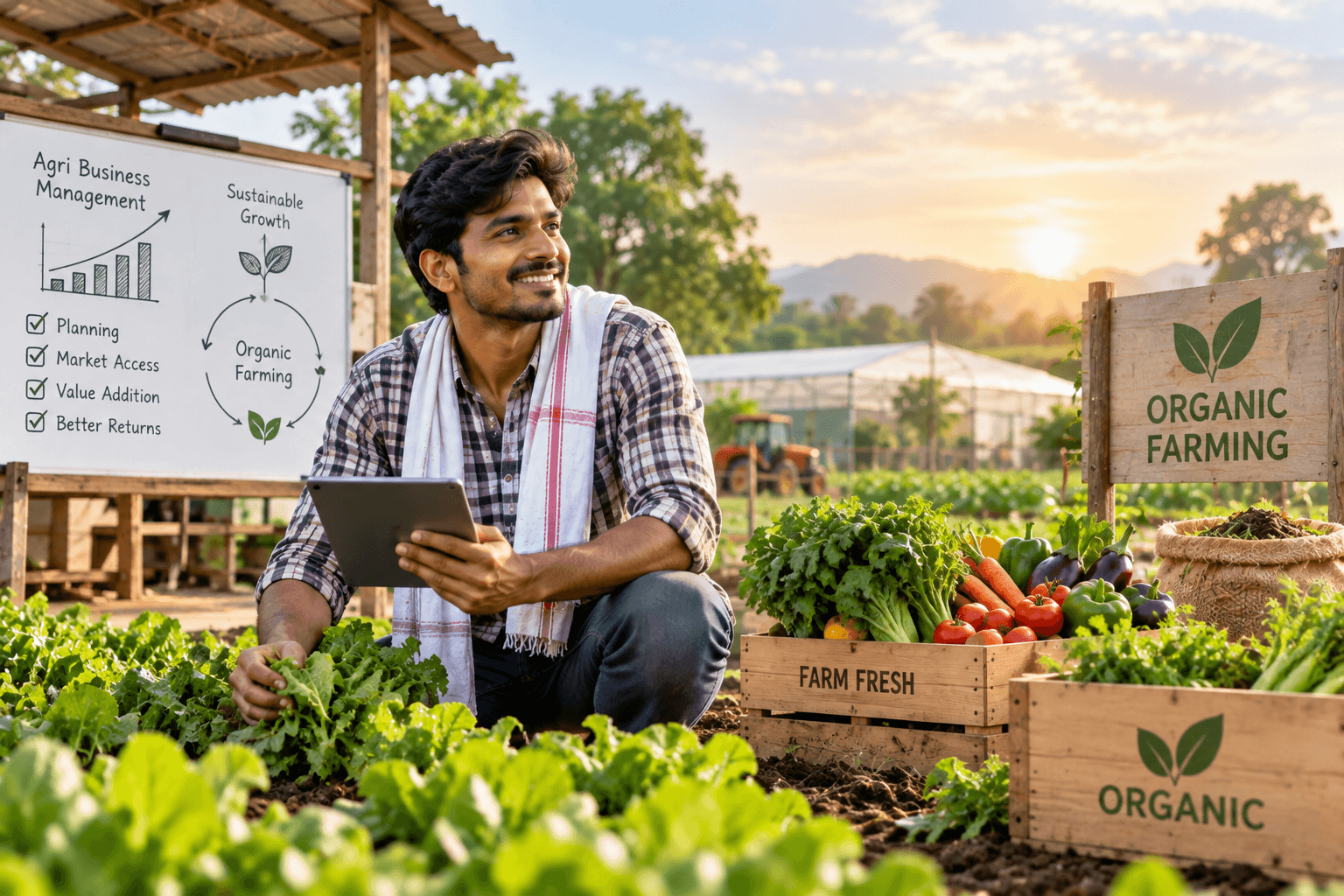
Why Agri Business Management and Organic Farming Are the Perfect Combination for Modern Farmers
-
by
admin
- No Comments on Why Agri Business Management and Organic Farming Are the Perfect Combination for Modern Farmers
Introduction
- Modern agriculture is evolving beyond traditional farming practices.
- Today’s farmers need to focus on sustainability, profitability, and market competitiveness.
- While Organic Farming ensures environmentally responsible production, Agri Business Management helps transform farming into a profitable enterprise.
- Together, these two approaches create a strong foundation for long-term agricultural success.
- This blog explores why combining business management with organic farming is the key to building a future-ready farming business.
The Evolution of Modern Agriculture
Modern agriculture is starting to go past classic farming by weaving sustainable techniques together with clever, business minded choices. In the end it helps farmers raise profits, while also responding to market changes that keep showing up.
Changing expectations from agriculture
Right now, farmers are kind of expected to deliver safe, high-quality food, all while caring for the environment too.
Rise of business-oriented farming
Farming is more and more turning into a real venture, where planning, promotion, and money management matter just as much as growing itself.
Growing opportunities in organic agriculture
The demand for organic goods keeps, rising so growers who switch to more sustainable practices can often reach steadier earnings routes too.
Understanding Organic Farming
Organic farming is like a natural way of farming, it is focused on good soil, safer food, and overall environmental sustainability and not just one thing, you know.
What is organic farming?
Organic farming grows crops without synthetic fertilizers or using chemical pesticides, it keeps things more “natural” for sure.
Principles of organic farming
This kind of approach is more like following natural ways of growing, focusing on soil vitality, liveliness across different species ,and patient sustainable routines, not chasing quick fixes or shortcuts.
Benefits of organic farming
It can help reinforce soil fertility, give a hand to environmental protection, and at the same time provide people with crops that tastes and feels sort of more wholesome to eat, overall.
Understanding Agri Business Management
Agri business management is basically how farmers handle their daily work as a profitable but also sustainable enterprise, not just planting and waiting.
What is Agri Business Management?
In a simple way it means planning, managing and also marketing farm outputs so profits can grow, while things stay steady in the long run.
Key areas of agri business management
This usually covers finances, marketing, the supply chain side, production activities and business planning in general.
Why business knowledge is essential for farmers
When farmers have real business knowledge they can make smarter decisions, trim unnecessary expenses and boost income, little by little it becomes much easier.
Why Organic Farming Alone Is Not Enough
Agri business management is basically how farmers handle their daily work as a profitable but also sustainable enterprise, not just planting and waiting.
Challenges in selling organic product
In a simple way it means planning, managing and also marketing farm outputs so profits can grow, while things stay steady in the long run.
Importance of branding and customer awareness
This usually covers finances, marketing, the supply chain side, production activities, and business planning in general.
Need for efficient business planning
When farmers have real business knowledge they can make smarter decisions, trim unnecessary expenses, and boost income, little by little it becomes much easier.
How Agri Business Management Strengthens Organic Farming
Agri business management supports organic growers to get more efficient, boost profits, and basically grow the whole operation, bit by bit.
Better production planning
When planning is done right farmers can use resources wisely and push productivity up, even during tricky seasons.
Financial management
Keeping an eye on costs and income helps farmers get steadier returns , and usually stronger profit margins.
Branding and marketing
When branding is alongside marketing, it gets easier for organic items to land in front of wider crowds, not only local buyers.
Supply chain optimization
If the supply chain runs smooth, the products arrive faster and they still keep their good state, it really matters for organic quality.
Benefits of Combining Organic Farming and Agri Business Management
When organic farming is paired with business management, farmers can end up with something more steady and more profitable, yeah, like a sustainable agricultural venture.
Higher profitability
With smarter planning, plus practical marketing, farmers can raise their income over time.
Stronger brand value
Having a credible brand pulls in new buyers and keeps people comming back, in a loyal way.
Access to premium markets
Reliable organic goods can move into higher-value domestic and international markets, where quality actually matters.
Better risk management
Solid business planning supports farmers in dealing with market swings and financial pressures.
Sustainable long-term business growth
This blend supports slow , steady expansion, while also safeguarding the environment ,and it helps keep the whole operation on course for longer time.
Business Opportunities for Modern Farmers
Modern farming brings a bunch of ways to earn more, especially when organic production is paired with smart day to day business habits, you know.
Organic vegetable and fruit farming
Planting organic fruits, and vegetables matches the rising need for fresher, healthier food. It’s kind a straightforward way, for folks to eat better with no weird add-ons, you know.
Value-added organic food products
Turning raw items into products such as organic spices, fruit juices, or snack packs makes the whole offer feel worthier, and yes profits often rise.
Farm-to-consumer business models
Offering products straight to buyers, meaning local shoppers and nearby communities, can lead to better payouts.
Organic retail brands
Building an organic retail brand helps create credibility, and that usually pulls in repeat customers who stay.
Export-oriented organic businesses
Shipping organic goods abroad can unlock bigger premium international markets, and more buyers in general.
###
How Consumers Benefit from This Approach
When organic farming is paired with solid business practices it tends to help both the people buying and the environment at the same time, even if that sounds sort of obvious.
Safer and healthier food
Food from organic farms is typically grown using natural, sustainable methods, not a bunch of harsh shortcuts.
Improved product quality
With improved farming and careful handling, products usually show up fresher and with higher overall quality.
Greater transparency and trust
Clear labeling, plus certification , gives shoppers a real chance to choose with confidence and a bit less guessing.
Sustainable food production systems
This overall approach backs farming practices that help protect the land and waters, so future generations can still have options.
Real-World Impact / Example Scenarios
Case 1 – Farmer building a successful organic vegetable brand
A farmer managed to create a trusted brand for organic produce, which helped pull in more customers and yes increase overall sales.
Case 2 – Agripreneur increasing profits through business planning
Through better planning and sharper marketing , an agripreneur managed to lower expenses and earned higher profits, without too much chaos.
Case 3 – Organic farming enterprise expanding into premium retail markets
An organic farm leaned on strong branding plus sturdy packaging, so it could step into those premium retail stores, and then slowly scale the entire thing.
###
Common Challenges Faced by Organic Farmers
Organic growers often handle roadblocks that can slow down business growth and weaken their profitability sometimes more then they expect.
Higher initial transition costs
Moving toward organic farming usually asks for extra time and extra investment right at the start, it’s not instant.
Limited marketing knowledge
A lot of farmers end up stuck trying to promote, and then sell their products in a way that actually works.
Difficulty reaching premium buyers
It can be hard to locate customers who truly care about organic goods, and who are willing to pay the higher price.
Lack of business management skills
**Without solid business insight, farmers may have a tough time with scheduling, pricing, and overall expansion.
How Skill Development Helps Modern Farmers
Skill development really helps farmers boost output, handle the whole farm as a business, and raise overall profit, in a steady way.
Learning organic farming techniques
Learn organic farming through training sessions , a lot of hands-on workshops, and guidance from seasoned farmers. Go for natural, earth friendly ways like making compost, doing crop rotation, and using eco minded pest control. It’s kind of a steady approach not a quick fix, you know.
Developing business management skills
Business know-how gives farmers the tools to control costs, plan marketing, and keep profits growing in a practical manner.
Understanding market trends and consumer demand
When farmers learn what buyers actually want, they can cultivate the correct crops or products and get better sales, faster.
Building entrepreneurial confidence
Training also builds confidence, so farmers can begin, run and even expand their own venture, step by step.
Role of Institutions Like SIILC
SIILC is doing work that helps students, and farmers, get practical know-how so they can build a solid career in modern agriculture, it’s like a real on the ground thing not just theory.
Agri Business Management programs
These programs focus on business planning, marketing work, and how to manage a farm, in a sensible way. Learners get the kind of skill set that can actually translate into daily decisions.
Organic Production Certification training
**Students go through organic farming standards and the certification process, bit by bit. They learn what needs to be documented, and how the whole approval path works.
Entrepreneurship development
This training pushes learners toward starting, and then growing their agribusiness. It is about more than ideas, it builds capability, patience and direction too.
Industry-oriented learning
Hands on learning is organized around actual agricultural careers. Students aren’t only watching, they are doing the work, so moving into the industry feels smoother than in the past.
###
Future Trends in Organic Agribusiness
Organic farming is still expanding, fairly quickly too, mainly because people want food that feels more health supporting and farms that also hold up better over time. You know, that eco mindset, it’s building up little by little, step by step, and all that.
H3: Rising demand for organic products
More people are picking organic food, not just for taste either, but for a sort of healthier lifestyle in general.
Growth of direct-to-consumer agriculture
Farmers are selling to their own customers more often, kind of straight from the source. Lately this is happening through online shops and local markets, and also via simpler neighborhood routes.
Increased adoption of sustainable farming practices
More farms are taking on environmentally kind methods, like soil care and water saving routines, to help keep the surroundings in better shape.
Technology-driven farm management
Digital tools are becoming common on farms, and they let growers manage things better, boost productivity and make clearer business decisions too, sometimes faster than before.
Building a Future-Ready Organic Farming Business
So, basically a future-ready organic farm is more than “just growing stuff” it blends sustainable farming practices with a few smart business choices, so you can keep going long term without getting stuck.
Focus on quality and sustainability
You want produce that feels top-tier, while also protecting the land and the surrounding environment in a real practical way.
Develop strong business planning skills
When the farm plan is clear, profits usually improve, and day-to-day operations get easier to manage, you know, less confusion more rhythm.
Invest in branding and customer engagement
Branding is what makes people trust you, and when customers feel connected they tend to come back, that’s the whole point.
Explore domestic and export market opportunities
If you expand beyond local demand, it can push sales upward and support broader business growth, including for export pathways and new buyers.
Conclusion
Organic farming plus Agri Business Management, kind of work together, so farmers can shape sustainable profitable, and future ready operations. When smart farming techniques and solid business know how come in the same picture, farmers can better match the rising demand in the market and keep moving toward long term success.
- Call to Action: Register for SIILC’s Agri Business Management and Organic Farming programs. You’ll pick up the kind of knowledge and hands on skills that can help you build a successful, and yes, sustainable farming business.
FAQs
- What is Agri Business Management?
Agri Business Management is basically the process of running farming like a business so that both profits and growth can happen, bit by bit.
- Why is organic farming becoming more popular?
People often go for organic food, mostly because it’s grown with natural means and approaches that feel more gentle to the planet, and so on.
- How does business management improve farm profitability?
It helps farmers handle their costs better, then improve marketing strategies and finally increase overall income, in a steady way.
- Can small farmers benefit from organic farming?
Yes, smaller farmers usually can achieve better returns by producing high quality organic products, then tracking down the right buyers in the right markets.
How can I learn Agri Business Management and Organic Farming? You can try joining SIILC training programs, to learn hands on things more quickly, plus pick up skills that actually match what the industry needs.